-
How Much Does a Commercial Pilot Course Cost in In

Description
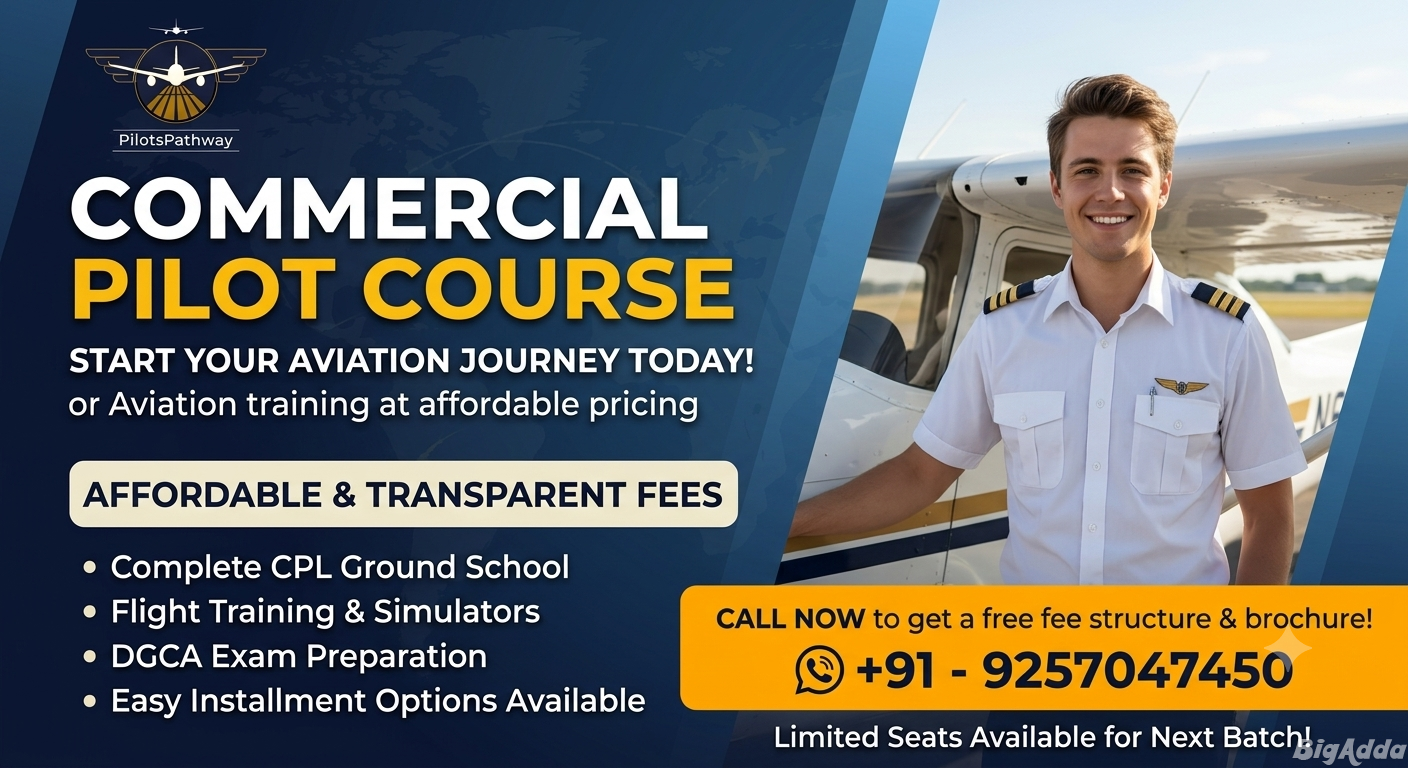
Every student who dreams of flying asks the same first question: what are the Commercial pilot course fees? It is a fair question. Pilot training is one of the bigger investments a family can make, so it helps to know where the money goes before you begin.
This guide explains the costs in plain words. It also covers the Air India cadet pilot program, why DGCA Approved Flight Training matters, and how Pilots Pathway can help you plan your journey.
What Is a Commercial Pilot Course?
A commercial pilot course trains you to earn a salary as a pilot. When you finish and pass the DGCA exams, you receive a Commercial Pilot License (CPL). With a CPL you can apply to airlines, charter companies and other aviation employers.
The course has two main parts:
Ground classes: You study theory such as air navigation, meteorology, air regulations and technical subjects.
Flight training: You fly with an instructor, build your flying hours and practise skills until you can fly safely on your own.
Commercial Pilot Course Fees: What to Expect
The total Commercial pilot course fees in India usually fall between ₹35 lakh and ₹60 lakh or more. The exact number depends on the flight school, the aircraft, the location and how quickly you complete your hours. Please treat this as a rough range only and confirm current numbers with the school before you decide.
The main cost parts are:
Ground school fees. Classes for the DGCA theory papers.
Flying hours. This is the biggest cost. You need about 200 hours of flying for a CPL, and each hour in a training aircraft has a price.
Simulator training. Some hours can be done on a simulator, which costs less than flying a real aircraft.
Medical tests. You need a valid medical certificate from an approved aviation doctor.
Exam and license fees. Charges for DGCA exams, the student pilot license and the final CPL.
Extras. Accommodation, food, uniform, headsets, books and travel.
Why Do Fees Differ So Much?
Two schools may quote very different prices for the same license. Here is why:
Some schools have newer aircraft, which cost more to run.
Weather matters. Places with clear skies let you finish hours faster, and fewer delays means lower total cost.
Some quotes show only the flying cost, while others include everything.
Training abroad can have a different price structure from training in India.
Always ask for a full written breakdown. A low headline price is not always the real price.
The Air India Cadet Pilot Program
Many students ask about the Air India cadet pilot program. In a cadet program, an airline selects young candidates and sends them for structured training, with the goal of placing them in the airline after they qualify.
Here is what you should know:
Selection is competitive. Candidates are usually tested on aptitude, English, maths, physics and personal interviews.
Eligibility rules, fees, seats and training partners can change from one batch to the next.
A cadet program is not the same as a guaranteed job in every case. Always read the terms carefully.
Because details change often, check Air India’s official announcements for the latest rules. A good pilot training institute can help you prepare in the meantime. Strong ground knowledge, good English and a clear medical certificate make you a stronger applicant for any cadet program.
Why DGCA Approved Flight Training Matters
In India, the Directorate General of Civil Aviation (DGCA) controls pilot licensing. Your license is valid only if your training follows DGCA rules.
That is why you should choose DGCA Approved Flight Training every time. Here is what it gives you:
Valid hours. Your flying hours count toward your license.
Safety. Approved schools follow strict standards for aircraft, instructors and maintenance.
Better job chances. Airlines trust licenses earned through approved training.
Peace of mind. Your money goes to a recognised, proper course.
Before paying any fees, ask to see the school’s approval and the records for its aircraft and instructors. A trustworthy school will show them without any problem.
How to Become a Commercial Pilot
If you are wondering how to become a commercial pilot, here is the path in simple steps:
Finish class 12 with Physics and Maths. This is the standard requirement. You must be at least 17 to begin flying and 18 to receive the CPL.
Get a Class 2 medical, then a Class 1 medical. Check your fitness early, before you spend on training.
Complete the DGCA ground classes. Pass the theory exams, along with the English language proficiency test.
Start flight training. Build your hours with an instructor, and later fly solo and cross-country.
Pass the CPL skill test. A DGCA examiner checks your flying.
Receive your CPL. You are now licensed to fly commercially.
Prepare for airline jobs. Airlines look for strong interview skills, simulator readiness and type-rating preparation. A type rating is the extra training needed for a specific aircraft like the A320 or the Boeing 737.
The whole journey usually takes about 18 months to 2 years, depending on weather, aircraft availability and how fast you clear your exams.
Aviation Pilot Training in India: Is It a Good Choice?
Aviation pilot training in India has grown fast. Airlines are adding aircraft, new routes are opening and demand for pilots is rising. Training at home also lets you stay near your family and keeps costs lower than many overseas options.
Some points to keep in mind:
Aircraft and instructor availability differ by school.
Weather and airspace can affect your schedule.
Choose a school with clear communication, so you always know your progress and your costs.
PPL Training in India: The First Step
Many students begin with a Private Pilot License before moving to a CPL. PPL training in India teaches you the basics of flying, such as take-off, landing, navigation and handling emergencies. It needs fewer hours than a CPL, so it costs less.
A PPL is a good first step if you are not fully sure about a pilot career. You get a real taste of flying, and the hours you log still count toward your commercial training later.
How Pilots Pathway Can Help You
Choosing a school is the biggest decision in your training. Pilots Pathway is an India-based pilot training company that guides students from the first step to the final license. Its courses include:
PPL (Private Pilot License)
CPL Ground Training
CPL Flight Training
Flight Simulator Training
Airline Preparation
Cadet Pilot Course
Foundation Course
DGCA Ground Classes
Having all of these under one roof means you do not need to run between different institutes. You can start with a foundation or ground course, move into flying and finish with airline preparation, all in one clear path.
Pilots Pathway can help you understand fees, plan your budget and prepare for cadet programs and airline interviews, so your path stays simple and clear.
Tips Before You Pay Any Fees
Ask for a full fee breakdown in writing.
Confirm that the training follows DGCA rules.
Visit the school if you can and speak to current students.
Ask how many students share one aircraft, since fewer students means faster hours.
Check refund terms, payment plans and what happens if there are delays.
Look into education loans. Many banks offer loans for pilot training.
Final Words
Becoming a pilot takes money, effort and patience, but with the right plan it is very achievable. Know the Commercial pilot course fees before you start, pick DGCA Approved Flight Training, and learn what the Air India cadet pilot program expects from you. Begin with strong basics, ask honest questions and choose a school that treats you with clarity.
If you are ready to take your first step, Pilots Pathway is here to guide you from class room to cockpit.
Mention bigadda.in when calling seller to get a good deal


Similiar Ads